



Belleau Wood is where the Marine Corps became the legend we know of today. It’s the battle that gave birth to the term “Devil Dogs,” the fight that turned a small naval infantry branch into a legendary fighting force. Every Marine knows the name as each recruit is still required to learn the story.
But few remember that U.S. Army soldiers fought and died in the battle, charging alongside the Marines into German machine-gun and artillery fire. Though they suffered thousands of losses, most Americans don’t realize the role they played in one of the most legendary battles in American history.
The Army Moves to Block the Germans
Colonel Paul B. Malone was already racing his automobile toward the front when orders caught up to him on the night of June 1, 1918. The 40-year-old West Pointer commanded the 23rd Infantry Regiment, part of the 2nd Division’s 3rd Infantry Brigade. German forces had just punched a hole in the French lines west of the Marine positions. If the breach was not sealed, the entire American line could collapse.
Malone’s regiment had been in reserve. Now they had to move. The 23rd Infantry, along with the 1st Battalion of the 5th Marines and elements of the 6th Machine Gun Battalion, conducted a forced march exceeding ten kilometers through the darkness. They had no time for reconnaissance, no opportunity to study the ground.
By dawn on June 2, they had plugged the gap. The Americans now presented an unbroken front from Triangle Farm south toward the Paris-Metz Highway. The German advance had been checked, but the real fight was about to begin.
Attacking Alongside the Marines
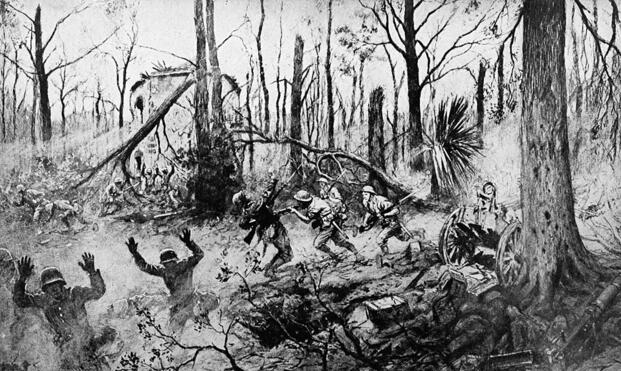
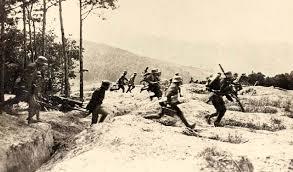
On the afternoon of June 6, the Marines launched their assault on Belleau Wood. History remembers this day for the waves of Leathernecks advancing through waist-high wheat under murderous machine gun fire. What history forgets is that the 23rd Infantry attacked with them.
The regiment received its attack orders just fifty minutes before the Marines jumped off at 5 p.m. Colonel Malone drove his automobile directly into the front line to ensure his battalion commanders understood their mission, sketching positions on their maps before being recalled to brigade headquarters. The 1st and 3rd Battalions of the 23rd Infantry were to support the Marine right flank, advancing toward the road connecting Bouresches to Vaux.
German Maxim machine guns opened fire from multiple directions. The right-flank platoon of the Marines had orders to hold fast, creating confusion about who was supposed to move and when. But the men of the 23rd could not restrain themselves when their comrades on the left were fighting for their lives. That evening, the soldiers climbed out of their positions and charged the enemy.
The regiment advanced roughly a kilometer through withering fire toward the road connecting Bouresches to Vaux. Machine gun rounds tore through the wheat from positions the Americans could not see. When the leading companies began to lose cohesion, Major Edmund C. Waddill moved into the open to reorganize them. Artillery and machine gun fire raked his position but he pulled scattered groups back into fighting shape and urged the attack forward. He earned a Distinguished Service Cross for his actions that day.
Behind the lines, casualties overwhelmed the aid stations. Chaplain Julius J. Babst refused to stay behind cover. He went out repeatedly into the artillery fire to reach the wounded men, administering last rites to the dying where they fell. He earned the first of his two Distinguished Service Crosses that evening in the wheat fields of Belleau Wood.
The Germans counterattacked at Hill 192. Malone committed his reserves and drove them back, but by midnight the situation had become untenable. Both battalions withdrew to their original positions. The regiment lost 27 killed and 225 wounded or missing in just seven hours of combat. The Marines too, suffered heavily.
Three Weeks Under Fire
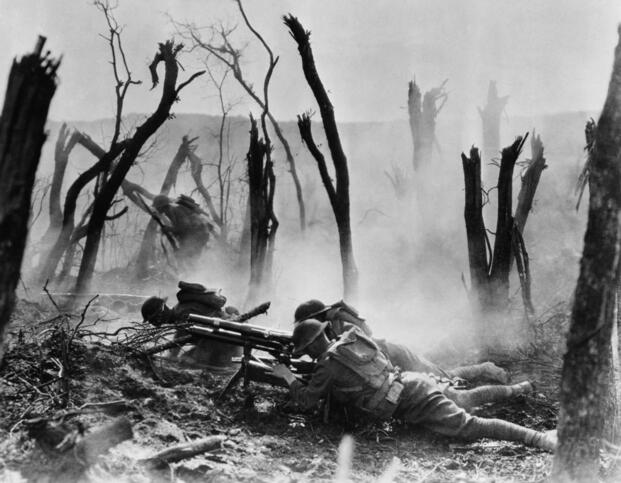
For the next three weeks, the 23rd Infantry held their sector on the eastern edge of Belleau Wood while the Marines ground their way through the forest to the north. German artillery pounded them daily. On June 14, the regiment took over additional positions, allowing the Marines to concentrate their depleted forces on their assaults.
Major Charles E. Elliott, a battalion commander in the 23rd Infantry, captured the frustration of combat leadership in a message to Colonel Malone.
“As some of the requests, orders and reports of some of the staff are so absurd, ludicrous, and in many cases impossible, I request that the following officers visit my C.P. as soon as possible to see situations for themselves.”
He specifically noted that no one could sleep within 1,300 yards of the front line unless in a gas-proof dugout with sentries posted. Such conditions would keep them awake permanently.
On the night of June 23-24, the Germans launched a devastating gas attack against the 3rd Infantry Brigade. Mustard gas shells mixed with high explosives rained down on Army positions.
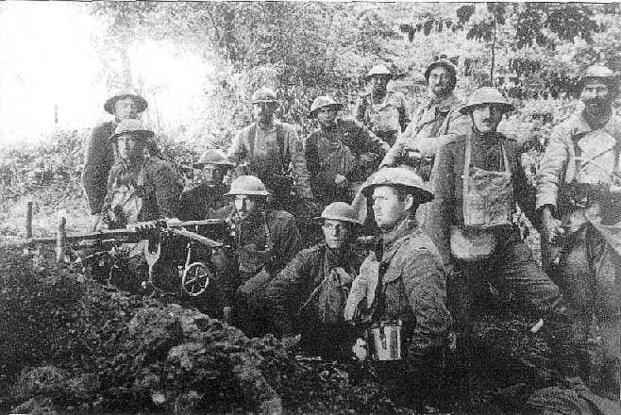
Over four hundred soldiers became casualties in a single night. The commander of the 23rd Infantry’s machine gun company reported that after the gas attacks, he did not have enough men to man each gun.
The 23rd Infantry managed to hold. For their service at Belleau Wood, the French government awarded the regiment the Fourragere, the same braided cord decoration given to the 5th and 6th Marine Regiments.
The 7th Infantry Regiment
By mid-June, the Marine battalions in Belleau Wood were battered. After ten days of constant heavy fighting, they needed relief. On June 15, Colonel Thomas M. Anderson, commander of the 7th Infantry Regiment of the 3rd Division, received orders placing his regiment at the disposal of the 2nd Division. That night, the regiment began relieving the Marines in the northern part of Belleau Wood.
What they found was a nightmare. Captain Walter R. Flannery of Company M later described the terrain.
“The Bois de Belleau was a mighty thick woods and it had been subjected to bombardment by the Germans and Allied forces as well. Trees twelve to fifteen inches in diameter were cut down like saplings and they made an almost impassable barrier where they had fallen,” he said. “The Germans had been there first, and they took advantage of the fact. They had machinegun nests trained down these lanes, and it was a darn tough job.”
When the 1st Battalion took over their assigned sector, they found a stronghold of German machine guns on the rocky ridges in the northern edge of the woods. An estimated 400 Germans opposed them.
Brigadier General James G. Harbord, commanding the 4th Marine Brigade, previously noted the ground was exceedingly rough, covered with dense underbrush, and all trails and paths seemed to be covered by machine gun fire.
These relatively inexperienced soldiers would now face the hell of Belleau Wood.
Eight Days Without Support
On the night of June 18, Company B of the 7th Infantry attempted to advance forward. Heavy machine gun fire forced them to withdraw with 5 killed and 16 wounded.
The following morning, Captain Paul Cartter of Company C led an attack with about 60 volunteers from Companies A, B, and C. They were hit by machine gun, rifle, and hand grenade fire which increased as they crawled toward the enemy. The push stalled as some of the men fell back. Undaunted, Captain Cartter took men from Company D and tried again, but the Germans held.
During the raid, machine gun bullets struck Private Ernest A. Rouch of Company A in three places. One cut a groove in his head, another passed through his shoulder, and a third went through his right ankle. He attempted to find his way back to American lines, but in a dazed state walked into the German lines and was taken prisoner. A German officer offered him a chance to return to his lines if he would promise never to fight against the Germans again.
Rouch reportedly replied, “The Germans could send him back to his comrades, but he was an American soldier and would fight to the end.”
The attack cost the Army 11 killed, 45 wounded, and 7 missing.
Despite these setbacks, Brigadier General Harbord sent a note to Lieutenant Colonel Frank A. Adams, commander of the 1st Battalion, advising him that they had “but one more opportunity to take the machine gun position and redeem themselves for the failure of the previous night.” The 1st Battalion would make a final attempt on the night of June 20.
Adams requested a heavy artillery concentration on the German positions, which was granted. To prepare for the bombardment, the battalion withdrew one kilometer to avoid short rounds. By 10 p.m., the company commanders had pulled back their men and awaited the artillery barrage.
The promised bombardment never happened.
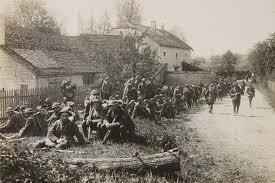
The attack began at 3:15 a.m. on June 21. Company A led the assault followed by Company C, while Company D remained in reserve. Company B drifted too far left in the darkness and failed to reach the objective. Companies A and C advanced up the hill but were forced back by heavy German resistance.
In some parts of the woods, the Germans allowed the units to push deep into their lines before opening fire. First Lieutenant Carl C. Helm of Company A recalled that they had advanced to the top of the rise without a single shot being fired. He thought the Germans had retired.
“We were fired upon from all sides and from trees,” he later reported. “Machine guns on our both flanks and in our rear opened on us.”
The Germans employed treachery as well as firepower. Captain Flannery recalled, “There were any number of Boche dressed in American army uniforms, and I remember distinctly one of them jumping up on a rock and shouting in perfect English ‘Cease firing; you are killing your own men.’ There was some temporary confusion and in the pause they got busy with hand grenades. Those birds paid for that trick, you bet your life.”
At one point, a German in American uniform approached Lieutenant Paysley of Company A, pleading, “My God, you are not going to fire on your own men out there, are you? You are not going to kill your own men?”
It being apparent to Lieutenant Paysley that this officer was an enemy, he immediately shot and killed him.
During their eight days in Belleau Wood, the 1st Battalion, 7th Infantry suffered 337 casualties, including 2 officers and 34 enlisted men killed. This was 25 percent of their strength.
Captain I.R. Williams of Company C recorded his feelings about the 7th Infantry leaving Belleau Wood.
“To me who lost 24 out of the 47 men I took in that place, it is a sore point. We failed to take the hill, but we did not lose any ground. With a proper artillery preparation and a carefully planned attack, instead of an attack planned and executed in the darkness, the 250 casualties of the 1st Battalion, 7th Infantry would not have been in vain.”
The Marines Return
Beginning the night of June 21, the Marines began to replace the 7th Infantry throughout Belleau Wood. Private Claude Romine of the 82nd Company, 6th Marine Regiment, later reported what they found.
“We went back to Belleau Wood and found the Seventh Infantry almost wiped out…but they were still fighting the best they could.”
The Marines, rested, fed, and bolstered by new replacements, continued their attack into the northern section of the wood, with artillery decimating enemy positions. On June 26, Major Maurice Shearer of the 3rd Battalion, 5th Marines sent his famous message declaring Belleau Wood was entirely in Marine hands.
After being wounded and returning to the United States, Private Frank Dallas of Company L, 7th Infantry, stated, “The United States Soldiers fought at night and there was not a night that some were not killed or wounded. However, for every ten Americans killed the Germans gave up more. The carnage was great.”
The Capture of Vaux
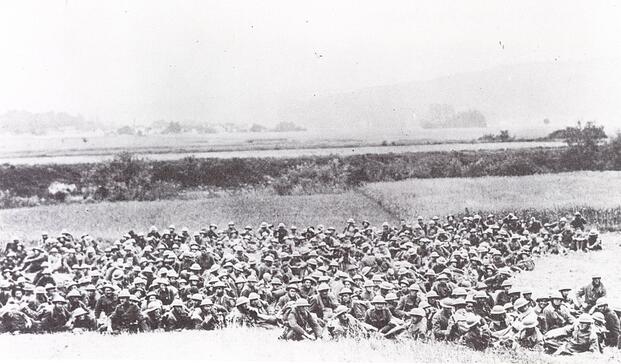
While the Marines and 7th Infantry fought in Belleau Wood itself, the other half of the 3rd Infantry Brigade held the critical southern flank of the entire American position. From June 1, the 9th Infantry Regiment was positioned between the Paris-Metz Highway and the Marne River, directly facing the German-occupied village of Vaux. Opposite them stood the German 398th Infantry Regiment of the 10th Division.
The 9th Infantry sent out aggressive patrols. Artillery and machine gun fire raked the lines nightly. On June 23-24, the same devastating gas attack that struck the 23rd Infantry also hit the 9th Infantry’s positions, causing hundreds of additional casualties.
The American line formed a deep bulge, required too many men to hold, offered a poor field of view, and lacked defensive depth. As long as the Germans held Vaux, the Marines’ newly won position at Belleau Wood remained vulnerable to flanking fire. Capturing Vaux would secure the entire sector.
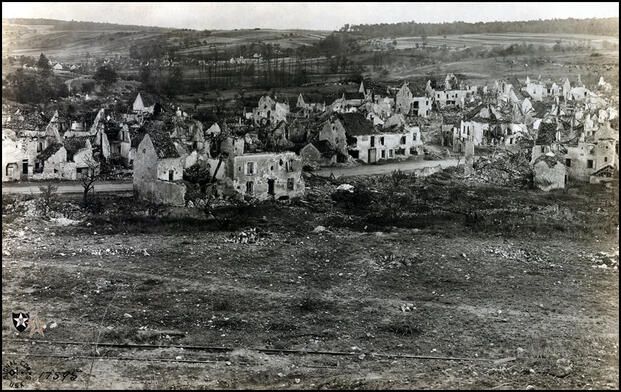
The planning was meticulous. German prisoners and captured documents were examined in detail. For the village itself, intelligence officers secured information from French refugees, including the village stonemason who had worked in every house in Vaux. Diagrams were prepared showing all eighty-two houses, with floor and cellar plans, the thickness of house walls, and dimensions of all garden walls.
On July 1, the two infantry regiments attacked side by side. The 23rd Infantry assaulted the Bois de la Roche on the left while the 9th Infantry under Colonel Upton took the village itself. For 12 hours, artillery hit the village. A rolling barrage preceded the assaulting infantrymen that evening.
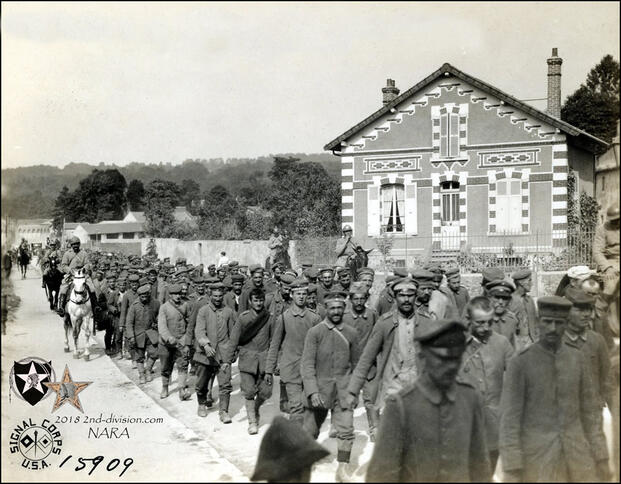
The artillery had done its work and drove the enemy to cover. Any Germans that attempted to resist were promptly killed. Within one hour after the barrage passed beyond the objective, all Germans remaining within it were killed or captured, and the Americans were digging in on the line as planned. A wounded German soldier who ran from Vaux reported to his commanders that the garrison there had been annihilated. The German counterattack against the 9th Infantry the following day failed.
The operation has been called one of the tactical gems of the AEF. It went almost entirely unnoticed as the Marines gained recognition for Belleau Wood.
Erased from History
During the war, press correspondents could not identify any unit by name or strength. They could not announce which divisions were fighting in a particular sector. The only identifier they could publish was “American troops.” However, they could mention specifics to branches of service such as artillery, the medical corps, or the engineers.
The correspondents, eager to give their stories character, asked General Headquarters if they could regard the Marines as a branch of the service and mention them in a general way. Someone in charge of censorship at Chaumont gave the go-ahead.
That decision transformed the entire Chateau-Thierry sector into a Marine Corps fight. Newspapers ran headlines like “Marines Crush the Prussian Line” and “Marines Use Up Three German Divisions in Week and Still Looking for More to Conquer.”
War correspondent Floyd Gibbons was wounded on June 6 while covering the Marine assault into Belleau Wood. His writing praised the Marines exclusively, with no mention of the Army whatsoever. An Army censor thought that he had died, and felt it wrong to censor a dead man’s words. Gibbons actually survived, though he lost an eye. Before anyone realized it, headlines across the U.S. praised the “Devil Dogs” that had broken through German lines in Belleau Wood.
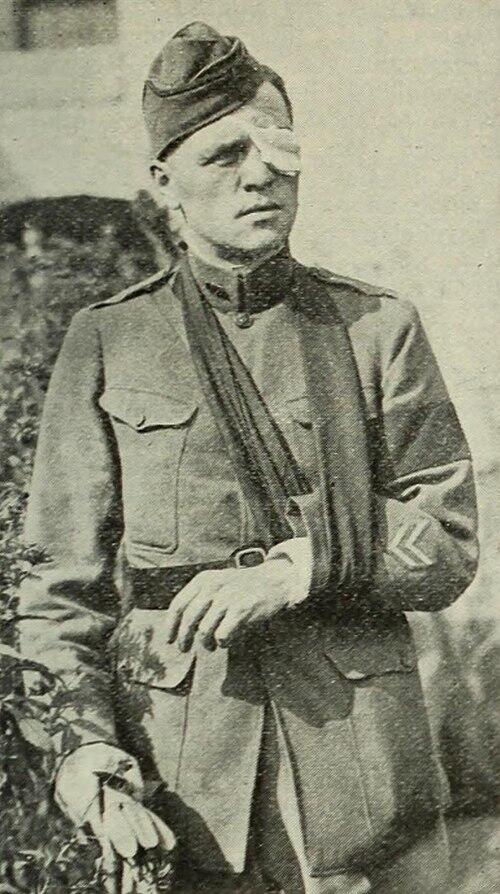
General Pershing, furious, immediately and personally relieved the officer responsible for the censorship decision. But it was too late.
As Sergeant Alexander H. Woollcott of Stars and Stripes later wrote, “The damage had been done. The reputation had been made. The ball had started to roll. It never stopped. It never will.”
Veterans of the 3rd Division tried to set the record straight. Major Paul C. Paschal, regimental staff officer for the 30th Infantry, wrote home, “It was the 3rd Division that stopped the German drive at Chateau-Thierry and not the Marines as some papers said. The Marines did the fighting in the Belleau Wood, but we sent the 7th Infantry up to help them.”
The Watch on the Rhine, a paper published by soldiers of the 3rd Division while on occupation duty in Germany, stated, “the purpose of exposing the falsity of these stories that have recurred so frequently is certainly not to discredit the work of the Marines, for we know that they fought well. But it is important that this entanglement be straightened out before historians gather up these untrue, exaggerated, and often ludicrous records, and use them as a basis for a history of the part America played in the great war.”
Even the Marines that fought in Belleau Wood were quick to praise the soldiers that fought with them. Many spoke of the heroic actions of the machine gun and engineer companies, even offering to buy them beer for their deeds.
The Legend of Belleau Wood
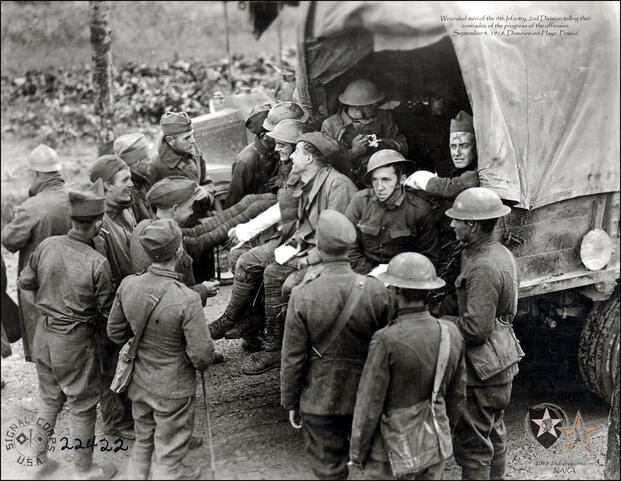
The 2nd Division fought in the Chateau-Thierry sector from June 1 to July 10, 1918. That sector included Belleau Wood, Bouresches, Vaux, and the surrounding positions. During those forty days, the division suffered almost 10,000 casualties.
The 4th Marine Brigade sustained roughly 4,000 of those casualties in Belleau Wood itself. They fought with extraordinary courage and earned their place in history. In fact, the losses during the battle exceeded all previous Marine Corps engagements in history combined.
The 3rd Infantry Brigade, consisting of the 9th and 23rd Infantry Regiments, suffered the other 6,000 losses while holding the flanks, attacking alongside the Marines on June 6, enduring the gas attack of June 23-24, and capturing Vaux.
The 7th Infantry Regiment, attached from the 3rd Division, took an additional 337 casualties during their eight days in Belleau Wood. Countless French soldier also died fighting alongside the Americans in the sector.

German after-action reports identified the 23rd Infantry, 9th Infantry, and 7th Infantry by name as American units fighting in the sector, alongside the Marines. French commanders awarded the 23rd Infantry the Fourragere, as they had for the Marines. The 9th Infantry received the French Fourragere later for gallantry during the Meuse-Argonne. Marines who were there witnessed the Army’s courage and sacrifice firsthand.
The Marines deserve their recognition, and rightfully earned their legend in Belleau Wood. But they did not fight alone.
The 23rd Infantry sealed a breach that could have collapsed the American line, then fought for three weeks under constant pressure. The 9th Infantry held the southern flank throughout the battle and captured Vaux in one of the most successful assaults of the war. The 7th Infantry relieved shattered Marine battalions and held for eight days while launching attacks without the support they were promised.
Three Army regiments helped win the Battle of Belleau Wood, but their sacrifices are too often forgotten by the nation.
Read the full article here