




The Homochitto River winds through the southwest corner of Mississippi and empties into the river that shares the state’s namesake. Other than Natchez, a preserved antebellum town, it’s a scarcely populated region, defined by historical markers and the dilapidated mills that stand in perpetual collapse along Highway 98, until it, too, runs out and empties into the backroads of Adams and Wilkinson counties. Insomuch as any southern town is defined by its past, this region remains tethered to its origins. Unless you were born in this place or married someone from here, you’d have no reason to go there. Local hunters, like Travis Murray, pray you keep believing that very thing.
As I creep down a narrow gravel drive, Travis directs me to a parking spot in his yard. A large pond borders one side of the drive while a dozer looms over the open field on the other. Pines from the Homochitto National Forest guard the far south end of his property like towering sentries. A flock of guineas scatters at my approach. I’m immediately greeted by a dachshund that gives the snarliest bark it can muster as it runs between me and its tall, wiry master.
“You look like an Adam,” Travis says, extending his hand as I step out of the car. Other than a few phone calls and texts, this is the first time Travis and I have met. I’m here to observe him hunt. One, because Travis has flown under the radar (by choice), so I’m intrigued by his obscure notoriety. Two, selfishly, I hope to glean some sliver of knowledge from a man who’s killed multiple Boone and Crockett deer from the ground.
But for more pure motives, I’m interested in his craft and dedication to hunting big deer with traditional archery equipment. Unlike most hunt-fluencers, Travis doesn’t care if anyone knows about the deer he kills. He prefers it that way. But it isn’t just Travis. He knows a lot of hunters in clubs around this part of the state, who prefer to keep their success under tabs. Perhaps that collective thinking of hunters in southwest Mississippi has helped preserve this Edenic deer hunting paradise.
Travis calls off his ferocious dachshund and invites me inside. It’s exactly what you’d imagine from a man who’s killed bucks that most hunters only see in their dreams. Giants line the wall. Like a Jackson Pollack, my eyes can’t tell where to start, but I know I’m looking at greatness. Even the smallest deer on Travis’ wall, most hunters would mount as their crowning achievement.
Among these deer, Travis’ other interests lie: the massive skull of a Russian boar named Goliath, a coyote nipping at a green head, and an alligator skin stretched over the back wall. His collection of coyote pelts would need their own closet. Travis loves shooting big bucks, but he’s well-versed in other game. Unlike most hunters who say they’re just as happy to go home empty-handed or shoot a doe, you actually believe Travis when he says it.
We run through the plans for that day. I’m to observe Travis while we do what he calls a “hunt-scout” through his property. While his hunting style might not be the most efficient in an age of modern compound bows and featherweight rifles, Travis is a man of practicality. He tells me we aren’t likely to find success hunting the way he does. It’s not conducive for more than one person.
He prefers to hunt with his longbow from the ground. Sometimes he makes what he calls a “hide,” ambushing deer on travel routes as he disappears in a ghillie suit or “slip hunts” (still-hunts) through a bedding area. Most of his shots occur inside ten yards. As bad as I want to observe the real thing, I settle for a good scouting trip. It’s hard to argue with a man who has more inches than a tape measure on his wall. Besides, it’s early November, and Travis doesn’t hunt until after a good frost.
After pondering the conditions, Travis tells me we’re going to scout-hunt through his property on the river. We load up into his mule to drive across the road where it starts. As we cross the road, Travis points to a brick house.
“My Uncle Red lived there,” he tells me. The property we scout has been in Travis’ family for generations. He’s hunted this land around and in the Homochitto National Forest his whole life, which included learning from Uncle Red. Travis’ father wasn’t around, so his grandfather and Uncle Red played a major role in his development as a hunter.
No one in Travis’ family bowhunted. In fact, his introduction to hunting, like many in the deep South, involved deer hunting with dogs or still-hunting. Travis would tag along with his Uncle Red, whose woodsmanship inspired and shaped Travis. Travis speaks of Uncle Red with reverence.
The awe is evident in his tone and animation when he notes how his uncle drifted through the woods like a puff of smoke. He describes Uncle Red as an opportunist. In a time before trail cameras or booming deer populations, antler inches meant little to Travis’s uncle or the local hunting community. Still, Travis emphasized that Uncle Red always killed the “most and best deer” because he was a woodsman. Uncle Red liked killing deer, and he was good at it. Travis has followed in those same steps.
As we ride through Travis’s property, he points out places where he or Uncle Red shot deer. He kills the side by side as we pass a stretch of hardwoods that opens into a field where Uncle Red shot a 140-inch eight-pointer. Travis fires up the mule again, and we descend a hill into an open pasture where a herd of does feed under a few white oaks in the corner.
Just before we get to the river, we spot another herd of does slipping through the edge of a slough. It’s been ten minutes and we’ve seen a dozen deer. Travis tells me he doesn’t hunt this property much anymore. He lets his preacher, son, and a few others hunt it. Most hunters might consider that crazy, given that Travis has some of the finest hunting land in the state at his disposal, a fact he admits. But for Travis, hunting isn’t about the end result.
We leave the pasture and drop down into a hardwood bottom. The trees begin to thin, and I can see the sky’s backdrop through the timber as it transitions to a sandbar. Travis points out a highway of deer tracks as he lugs the mule to the edge of the riverbank, which is only a few feet from the river itself. Here we get out and walk. The river is wide but low, knee-deep at most in some places. Others, the sand bottom emerges and shimmers in the sun. Travis points out a strip of public land across the river as he tells me about one of the biggest deer he’s killed.
One reason Travis hunts from the ground is because he loves the mobility it gives him. He’s killed several deer by what he calls spot-and-stalk, only in this thick country, it isn’t the spot and stalking you typically imagine. For instance, if Travis observes deer from a distance, he’ll anticipate where they will eventually cross. Once the deer get out of sight, Travis will drop back a few hundred yards and sprint to where he thinks they might eventually travel.
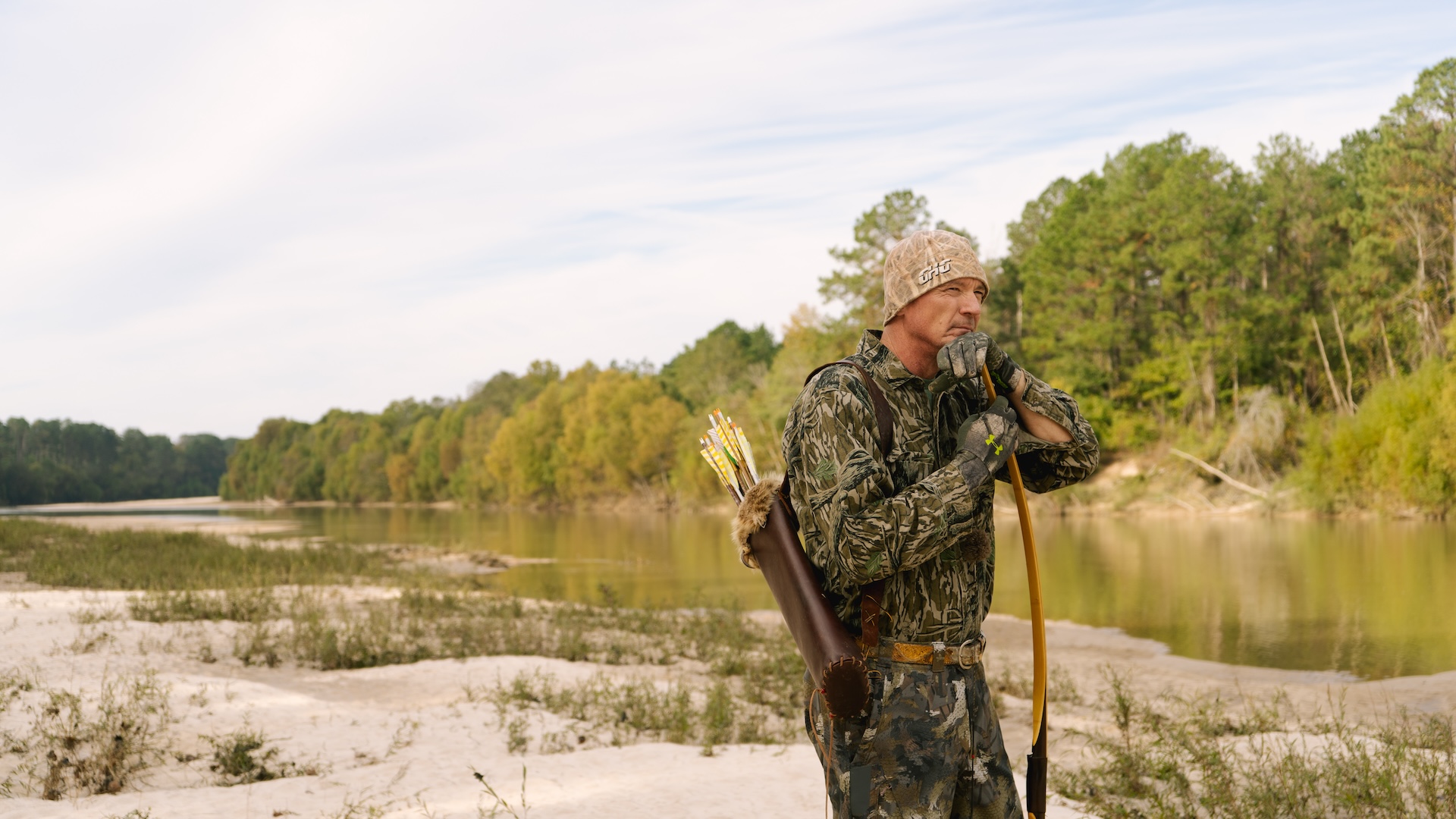
He admits that his familiarity with this land makes this hunting approach feasible, while acknowledging how tough that would be on foreign dirt. But in the case of the deer he’s currently telling me about, he likes to take a similar approach during the rut. Just as he begins his story, he stops and emphatically points across the river, “Look right there!” Startled, I quickly turn, expecting to see a big buck. “What a beautiful kingfisher,” he exclaims. “Now that is a magnificent creature.” Travis pauses and watches the bird glide over the face of the river until it vanishes from sight.
There are big buck killers out there who couldn’t tell you the name of the tree they’re hanging in. Travis isn’t one of them. His knowledge and love of wild animals and places isn’t the reason he hunts, but it has formed the way he reads and interprets deer sign. In fact, our meeting was delayed until November because he spent much of his fall in Alaska shooting brown bears (with a camera). He told me he’s just as excited to shoot something with his camera as he is with a longbow. After seeing his admiration for the kingfisher, I don’t doubt it.
Travis continues his story, recounting a group of does that traversed the river not far from where we stand. He noted that they crossed frantically, looking back toward the riverbank. Once they crossed and ran out of sight, Travis gathered his things from his hide and ran to the crossing. He found their tracks, backed off about fifteen yards, and quickly made another hide on the edge of the river. Not twenty minutes later, he watched a rack emerge from the opposite bank. A huge buck tailed the does’ trail, giving Travis a broadside shot and a boat ride with the buck.
Travis scans the banks of the Homochitto as if he’s looking for another kingfisher before we load into the mule and leave the river behind. As we’re driving back through the pasture, Travis pulls over at one of his kill sites to demonstrate how he makes a hide. We walk the edge of a hardwood ridge, at least, it’s what us flatlanders down South might call a ridge. I’ve seen cathead biscuits raised higher than this. Truly, it’s a small rise or knoll to anyone who actually lives in hill country.
The ridge runs east and west, but the north side slopes gently around the head of a slough, creating a subtle funnel. It’s an unassuming spot that most hunters might overlook, but it’s the exact place where Travis has killed several bucks traveling that funnel to feed under the oaks on an adjacent ridge.
Surprisingly, Travis tells me he doesn’t need much to make a good hide. Though he has one non-negotiable when it comes to hunting from the ground. “You have to have something over your head,” he tells me. “It could be anything.” We’re looking at the base of a large red oak when Travis breaks off a few snags of switch cane. He promptly shoves them into the dirt, forming a thin wall of cover. Like this spot, the hide doesn’t look like much, but Travis assures me that he can “get away with murder” in a ghillie suit.
One thing I notice about Travis’ hide is that there are no obstructed shooting lanes for obvious reasons. He says one mistake that hunters make is that they’re so afraid of getting busted, they don’t leave room for actual shooting windows. Ironically, Travis points out that shooting a longbow gives him an advantage over a compound. Instead of hitting the precise form that a compound demands, he can instinctively shoot a longbow from a variety of positions, so he’s able to get a shot off with minimal movement.
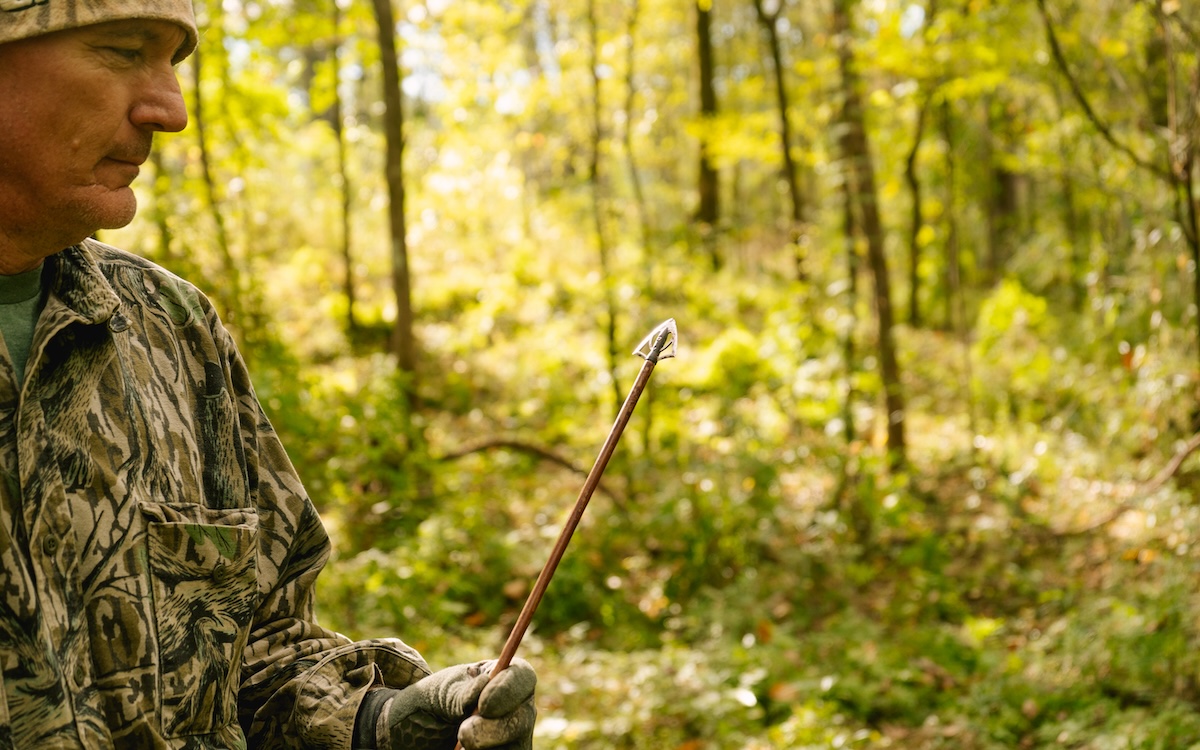
On our way back to Travis’ house, we stop at another spot. Travis makes some tweaks to a hide he plans to hunt after the first cold snap. Once he’s satisfied with the cover, he takes a shot from the hide, aiming at a single red leaf on the bank of a ridge. The shot is much farther (about thirty-five steps) than he would take on a deer, but he lets the arrow fly. It lands a few inches below the leaf. Satisfied with the shot, he plucks the arrow from the ground, shaking the dirt from the blunt end before stashing it in his quiver. Back at his house, Travis is kind enough to give me pointers on my traditional form as we shoot a bear target in his yard.
We spend the rest of the afternoon swapping deer stories. Travis points to countless mounts or piles of antlers, recounting each one. But like the kingfisher, other tales excite him too. I listen as he talks about the history of this region, the ring of dog fighters that ran a racket in his hometown before it became a federal crime.
He shows me the skull of a mammoth boar, corralled by Ellie, his beloved pit. Like Uncle Red, Travis speaks of her with passion and reverence. His voice breaks talking about her last hunts. Running through it all is the Homochitto River. Travis describes it as haunting. I can see it, the river rolling through those bottoms and sloughs, inconspicuous to the outside world. And it drifts unseen, like Travis or a puff of smoke.
Read the full article here