




The National Transportation Safety Board (NTSB) “vehemently opposes” a provision within the U.S. House-passed defense spending bill allowing military air training missions in Washington D.C., nearly one year after a crash in the area led to 67 deaths.
The $900 billion, 3,086-page National Defense Authorization Act (NDAA) that passed the chamber Tuesday on bipartisan lines includes Section 373 (Manned Rotary Wing Aircraft Safety) allowing the secretary of any military department to operate training missions around the Ronald Reagan Washington National Airport, known as DCA, even after the fatal collision between an American Airlines flight and U.S. Army Black Hawk helicopter on Jan. 25, 2025.
The NTSB, an independent government investigative agency headed by chair Jennifer Homendy, wrote a letter of concern to House and Senate chairs, ranking members saying that the NDAA provision does not enhance safety but rather “significantly reduces the safety around the [DCA] airspace.”
“In other words, this is a major step backwards from where we are today given the changes we made—rightfully—by the secretary of transportation [Sean Duffy] following issuance of NTSB’s urgent safety recommendations,” the letter reads. “We believe this provision effectively gives military aircraft operating training missions unfettered access to DC airspace.”
Military.com reached out to the NTSB, Department of Transportation and Federal Aviation Administration for comment.
January Crash & Investigation
The NTSB continues to investigate the January midair collision between a PSA Airlines CRJ700 airliner and the Sikorsky UH60 over the Potomac River near DCA, which led to the deaths of two pilots, two flight attendants, 60 plane passengers and three of the helicopter’s crew members.
Homendy, as the letter’s author, said the ongoing investigation has focused on limitations and gaps in traffic awareness, alerting, and collision-avoidance technologies like automatic dependent surveillance-broadcast (ADS-B).
An agreement between the FAA and Department of Defense that ensued following the crash required military aircraft in the D.C. airspace to broadcast their position via ADS-B Out—which NTSB has promoted for decades prior to the incident, according to Homendy.
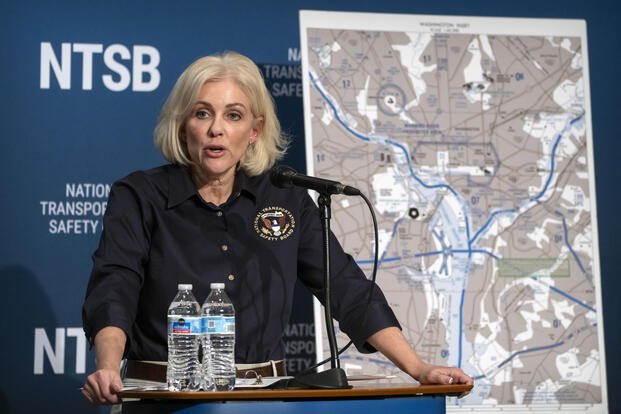
Yet the provision that remains in the NDAA would roll back that FAA-DoD requirement. Instead, aircraft in that vicinity must provide warning in “a manner compatible with the traffic alert and collision avoidance system” (TACS) of commercial aircraft. Homendy said in her letter that TACS is already in effect by design for aircraft 900 feet above ground level during descent.
When Flight 5342 crashed in January, it occurred at approximately 248 feet above sea level while on descent and a TACS warning went out about 20 seconds before the mid-air collision.
Homendy said she, NTSB have “serious concerns” of the broad authority provided within the NDAA that could give secretaries or general or flag officers the ability to waive TACS—saying that the Army and potentially other military departments “do not know [or] understand the complexities of the D.C. airspace” nor are they privy to how to conduct safety risk assessments or mitigation should a dangerous situation occur.
“The NTSB vehemently opposes Section 373 of the National Defense Authorization Act. … It does not in any way enhance safety. In fact, it reverses safety changes made after the mid-air collision,” Homendy told gathered media on Wednesday evening.
NDAA ‘Loophole’
U.S. Senate lawmakers on the Committee on Commerce, Science and Transportation also released a bipartisan, joint statement regarding the provision, saying it will make American skies “less safe.” Members included chair Ted Cruz (R-TX), ranking member Maria Cantwell (D-WA.), Jerry Moran (R-KS.) and Tammy Duckworth (D-IL).
“The families of the victims deserve accountability.”
“As drafted, the NDAA protects the status quo, allowing military aircraft to keep flying in DC airspace under different rules and with outdated transmission requirements,” the statement reads. ‘This comes as Pentagon data shows a spike in military aircraft accidents since 2020.
“The families of the victims deserve accountability. The NDAA should be stripped of this new loophole and instead include the ROTOR Act—a bipartisan bill that closes the dangerous exemption that allows military aircraft to operate in domestic skies without communicating their position. We must act decisively to prevent future tragedies.”
Families of Victims ‘Deeply Concerned’
Families of the victims of Flight 5342 also released statements about Section 373, saying in unison that the provision doesn’t resolve the visibility and coordination issues that led to the tragic deaths.
“These gaps mean the provision does not meaningfully mitigate the risks that proved fatal for our loved ones,” their statement reads. “We urge Congress to strengthen Section 373 by requiring real, enforceable visibility standards for all military aircraft operating near civilian traffic.”

Tim and Sheri Lilley, whose son, Sam, was the first officer of Flight 5342, said in their own remarks that the NDAA provision should be rejected and that ADS-B Out at a minimum should become law.
“The national security waivers allowed by this draft are also deeply concerning,” their statement reads. “As has been highlighted by public statements of several Members of Congress and administration officials, the national security waivers that have been abused by operators in the D.C. area are problematic and subject to abuse.
“This bill addresses that with a ‘window dressing’ fix that will continue to allow for the setting aside of requirements with nothing more than a cursory risk assessment. Safety that depends on exemptions cannot be the foundation of a secure airspace system. The flying public and all those that utilize our airspace deserve better than what this bill provides.”
Story Continues
Read the full article here