




In a unique partnership between the Intrepid Museum and FARO Technologies, one of America’s most historic aircraft carriers has been digitally preserved with millimeter-level precision, creating a 14.7-terabyte archive that captures every corner of the massive warship, including spaces that haven’t been accessed in decades.
The groundbreaking project documented the entire 872-foot Essex-class carrier using advanced laser scanning technology, producing more than 1,300 scan clusters containing millions of individual data points. The result is a comprehensive digital twin that preserves not just the ship’s physical structure, but the personal artifacts and human stories in its steel corridors.
Chris Malanson, the museum’s assistant vice president for exhibitions who led the Intrepid team, and Irene Radcliffe, senior business development manager at FARO who spearheaded the technology company’s efforts, spoke with Military.com about the complex undertaking that became FARO’s most challenging cultural heritage project to date.
A Project Born from the Pandemic
“The Intrepid is the same real estate as the Empire State Building turned on its side,” Malanson said. “None of us understood the magnitude when we jumped into it.”
The collaboration began when museum architects expressed interest in applying 3D scanning technology to a historic site. Initial discussions about documenting the ship’s second deck for restoration planning evolved into something far more ambitious when COVID-19 forced the museum to close to visitors.
“Because the ship was closed, we were able to scan the public areas,” Malanson explained. “That turned into a happy accident” that allowed unprecedented access to spaces normally filled with tourists.
What started as a training exercise for FARO staff became an exhaustive documentation project that opened compartments sealed for years, revealing maintenance issues, personal artifacts, and the everyday details of life aboard a warship where the average crewmember was just 18 years old.
The Technology Behind the Digital Twin
The scanning technology employs lidar-based laser systems mounted on tripods throughout the ship’s 13 decks. Each scan captures approximately two million measurement points as the scanner’s mirror system spins rapidly on a horizontal plane, bouncing lasers off surfaces to collect precise distance and positional data.
“It’s tripod-based,” Radcliffe explained. “You put the scanner in a location, it spins around and captures everything it sees—the ceiling, the walls, all of it—then you go to the next room and create an overlap.”
The overlapping scans are stitched together to create complete three-dimensional representations of each space. Color imagery adds texture and context to the point clouds, producing photorealistic digital models that preserve every detail down to vintage cartoon characters painted on bulkheads by crewmembers decades ago.
“This was our most complex project,” Radcliffe said. “We did quite a lot of scanning projects around the world. This one was unique in its volume and challenging environment—so many tight spaces.”
The team navigated narrow passages, steep ladders, and compartments designed for 1940s-era sailors, not modern scanning equipment. “Carrying a tripod and $60,000 scanner up railings that aren’t normal stairs, at angles that aren’t normal—that was physically challenging,” Radcliffe noted.

Discovering the Human Side of a War Machine
The project opened spaces that had remained sealed for years, offering glimpses into the lives of thousands of sailors who served aboard Intrepid from her 1943 commissioning through her 1974 decommissioning.
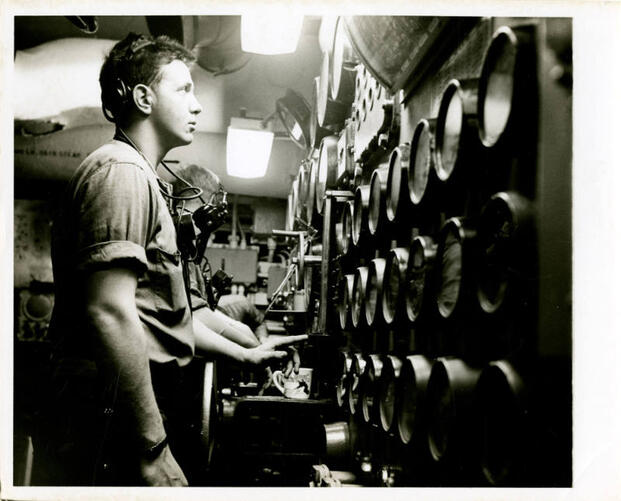
“Each day was a new discovery,” Malanson said. “An aircraft carrier is a small city all in of itself—a shoemaker, food service, a barber, laundry, hobby rooms. They’re not military 24/7.”
The team discovered crew artwork, including cartoon characters from the era painted on bulkheads. “They decorated parts of the ship to humanize this war machine,” Malanson said. “Not something to show up in a blueprint or Navy document—you will only find it when you go into the compartment.”
Among the more unusual discoveries were strange chemical reactions where dissimilar metals had been corroding together, creating orange stalactite-like formations growing from aluminum storage racks. “We identified where leaks were coming from, some conditions we didn’t know existed, and we remedied them,” Malanson explained.
The scanning also revealed forgotten personal items—old cigarette packages, a can of beans—left behind by long-ago crewmembers. “The artwork is phenomenal,” Radcliffe said. “Even the feeling going into the spaces, the hair goes up on the back of your neck. People were here.”

A Ship with Battle Stars
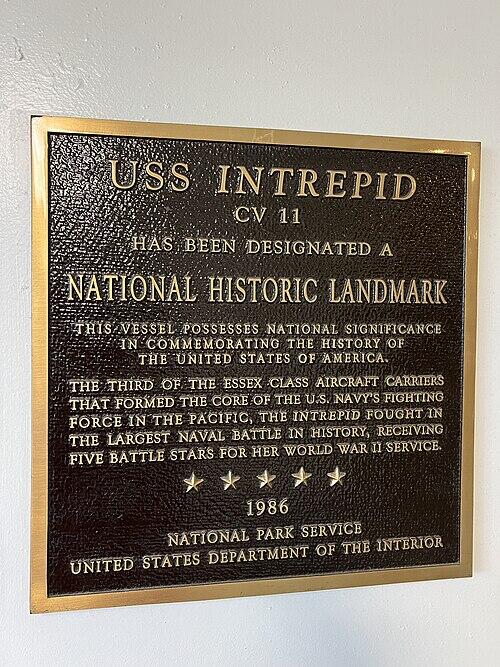
Commissioned in August 1943 at Newport News Shipbuilding in Virginia, USS Intrepid earned five battle stars during World War II and three more for Vietnam service, becoming known as “The Fighting I” for her prominent combat role.
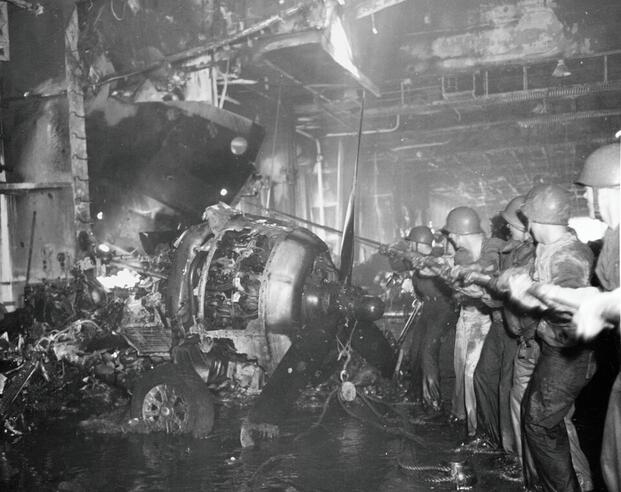
The carrier survived fierce combat during the Pacific campaign, including a February 1944 torpedo strike that jammed her rudder and forced the crew to rig an improvised sail from canvas and hatch covers to steer back to Pearl Harbor. She endured five separate kamikaze attacks, including a devastating November 1944 attack that saw two Japanese aircraft strike within minutes of each other, killing dozens of sailors in a single battle.
After World War II, Intrepid was modernized with an angled flight deck and enclosed bow, allowing her to operate jet aircraft during the Cold War. The carrier recovered astronauts from Mercury and Gemini space missions in the 1960s, racing other carriers for the honor of retrieving the capsules. During three Vietnam deployments, her aircraft set records for what’s believed to be one of the fastest aircraft launching times ever recorded by an American carrier.
Preserving History, Improving Preservation
The digital archive serves multiple practical purposes beyond virtual tours and educational programs. Museum staff used the scans to discover previously unknown structural issues and plan restoration work without disrupting historic spaces.
“We now had all of that information,” Malanson said, referring to the accurate digital record that surpassed the ship’s original hand-drawn blueprints. The Navy had never properly documented decades of modifications made during the carrier’s 31-year service life.
The museum used scan data to plan installation of a new life safety system for the second deck, routing sprinkler systems through the historic spaces with minimal physical impact. “We were able to plan that out on paper before crews and workers came in,” Malanson explained. “We didn’t disrupt the physical environment that we are restoring.”
Beyond high-profile restoration projects, the technology proves invaluable for routine maintenance tasks. While laser scanning’s applications in industrial facilities, oil refineries, and commercial buildings might seem mundane compared to preserving historic warships, those everyday uses demonstrate the technology’s practical value.
“Even the mundane things are important,” Radcliffe said. “The real beauty comes with the mundane.” Rather than measuring pipes and equipment with tape measures in cramped spaces, maintenance teams can use laser scans to plan upgrades and repairs from their desks, improving safety and efficiency.
The technology also enabled precise work on delicate artifacts. When a Japanese kamikaze propeller needed to be displayed but was too fragile to touch directly, the team used highly detailed scans to design a custom support structure and climate-controlled enclosure. “We could scan to reverify these dimensions for these objects to display them to the public using this technology,” Malanson said.
Opening Restricted Spaces to the World
More than half of Intrepid’s interior remains closed to visitors for safety and preservation reasons. The scanning project is changing that through virtual reality experiences and interactive displays.
The engine room ranks among the most requested areas. “Not a day goes by without a visitor asking how to get to the engine room, but we can’t let them down there,” Malanson said. Using scan data, the museum created VR experiences that allow people to explore the three-story-tall compartment with its five-foot-diameter pipes and massive machinery, meet virtual crewmembers, and learn about their jobs.
The museum is developing similar experiences for other restricted areas, including operating rooms, berthing spaces, the post office, barbershop, and torpedo assembly rooms. They’re also using scan data to create interactive displays that trace complex systems from the ship’s bottom to top, showing how aircraft were launched through animations that follow the process from steam generation in boiler rooms through catapult systems on the flight deck.
“You just can’t tell that story in another or better way than you can with this technology,” Malanson said.
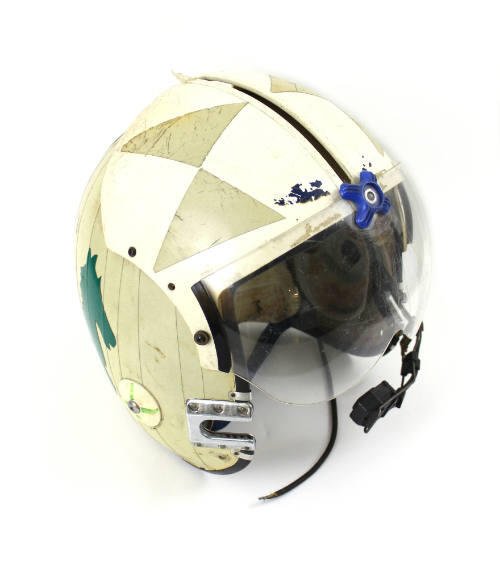
The museum plans to expand the project to scan and digitally display its entire aircraft collection, allowing people worldwide to rotate, zoom, and examine details of flight helmets and other artifacts that would otherwise remain in storage.
Looking to the Future
Both Malanson and Radcliffe emphasize that the project represents just the beginning of what’s possible with the technology. The motivation behind the effort extends beyond technical achievement—it’s about honoring the people who served.
“What makes the Intrepid worth preserving in this cutting-edge way is our crewmembers,” Malanson said. “We still have a lot of crewmembers—even 25 years ago, still WWII crewmembers, now it’s more Vietnam—they still come to the ship and volunteer, they bring their experiences from life, during and after service.”
Those veterans share how their time aboard Intrepid affected the trajectory of their lives, creating connections between past and present that make the museum more than just a collection of artifacts. “They love sharing that with the public,” Malanson said. “One of the greatest aspects of the ship.”
The museum’s mission centers on helping visitors understand the price of freedom, but Malanson noted that what most people experience surprises them. “They think they’re just gonna see a big vessel, when they get here, because of those crewmembers, the archives, the oral histories we incorporate into our exhibitions, it helps them understand how this machine functions. It catches them off guard. They walk away surprised.”
For Radcliffe, the project offered more than technical challenges. “It was the honor of a lifetime,” she said. “I’m very grateful to be part of this project. I met so many of the veterans.”
“We just started to scratch the surface of what we can utilize this for,” Malanson said. “We are 100 percent committed to exploring this and using this as a powerful tool to better explore and present our history.”
The museum continues developing new applications, with plans to create augmented reality experiences where visitors can use tablets to see virtual reconstructions of spaces—surgeons operating, sailors sleeping, writing letters, or playing cards—overlaid on the actual compartments.
The project has also attracted attention from the U.S. Navy. “I had a call with the Navy,” Radcliffe said. “They had seen the video, they were excited when they saw that.” Navy scanning teams that typically work with drydocks and piers expressed particular interest in the vessel scan methodology and results, seeing potential applications for documenting active fleet units and facilities.
The digital preservation ensures that future generations can explore and study the historic carrier with unprecedented detail, preserving not just steel and machinery but the human stories of the thousands of young Americans who served aboard “The Fighting I” during some of the most consequential years of the 20th century.
A video detailing the collaborative project between FARO and the Intrepid Museum can be viewed on YouTube. The Museum is located at Pier 86 on the West Side of Manhattan, New York City. More information about the project, as well as online and mobile VR experiences, are available on the museum’s website.
Story Continues
Read the full article here