




Drone sightings near airports, borders and federal sites have climbed in recent years. The Pentagon wants a faster way to fight back.
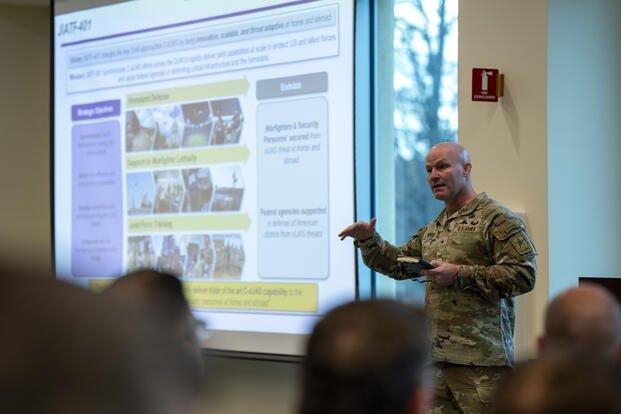
The U.S. Army has been tasked to lead the creation of a federal digital marketplace under Joint Interagency Task Force 401 that is intended to sort, test and share information about counter-drone systems for agencies that need tools safe enough to use around aircraft, communications and crowded public spaces.
The portal, envisioned as a single source for vetted technology, comes at a time of rising drone incidents nationwide and when agencies often lack unified testing data or clear guidance on what works.
Military.com reached out to multiple agencies involved in the effort for comment.
The Defense Department announced the establishment of JIATF-401 with a mission that includes improving how federal partners evaluate and acquire counter-UAS capabilities. The task force is planning a central online hub where federal users can compare systems, view government testing information, and understand operational limitations before buying or deploying equipment.
The Army has been named the Defense Department’s executive agent for counter-small UAS and is working with the Office of the Secretary of Defense, DHS components, the FAA and other federal partners.
Military.com asked the Defense Department, the Army, DHS Science and Technology Directorate, U.S. Northern Command, the FBI and FEMA’s grants directorate for comment about their roles, timelines or procurement plans.
FAA’s Safety Focus
The Federal Aviation Administration (FAA) told Military.com its work inside that federal ecosystem focuses solely on safety, saying it is a safety regulator rather than a security agency. Its role is to ensure drones operate safely within the broader National Airspace System.
The FAA is a safety regulator rather than a security agency.
“Congress gave certain federal agencies authority to counter credible threats from drones,” an FAA spokesperson told Military.com.
The agency noted it has tested drone-detection tools at airports and is expanding that work to off-airport locations to examine interference risks. It pointed to its UAS Detection and Mitigation Systems Aviation Rulemaking Committee, which produced 46 recommendations on how detection and mitigation equipment can operate without threatening the safety of the airspace.
The spokesperson provided no remarks when asked how closely FAA testing and evaluation processes might align with the Army’s planned marketplace.
Marketplace Aims to Fix a Growing Problem
Drone incidents increased nationwide as criminals, hobbyists and foreign actors found new ways to exploit cheap off-the-shelf aircraft. Public statements about the effort describe the marketplace as a way to centralize performance data and help agencies choose systems that work in their environment without creating new risks for aircraft, communications or public safety networks.
Reviews of counter-drone programs have found that uneven testing standards and reliability issues slowed adoption across multiple federal agencies, leaving operators with tools that often performed inconsistently in complex environments.
Agencies responsible for airports, borders and major public venues often lack reliable information about which counter-UAS systems are safe and effective for their missions.
Assessments of earlier deployments and federal test campaigns have noted that inconsistent data, operational constraints and interference concerns contributed to slow adoption and fragmented use of counter-drone tools. Analyses of federal counter-UAS efforts have described long-standing challenges with overlapping authorities that complicate agency coordination and delay unified responses to emerging threats.
One Hub, Many Missions
The marketplace is intended to serve as both a technical library and a practical guide for agencies that lack their own testing infrastructure. The concept reflects years of reviews, exercises and briefings that pointed to uneven standards across agencies using similar tools to protect high-risk sites.
Supporters say the move could shorten acquisition timelines for agencies confronting fast-evolving threats. It could also help civil authorities make faster decisions during major events or emergencies where drones pose risks to crowds, aircraft and critical infrastructure.
The Pentagon has not announced when the marketplace will go live or what systems will appear first.
Story Continues
Read the full article here