




The $900 billion National Defense Authorization Act (NDAA) for Fiscal Year 2026 passed the House of Representatives on Wednesday in bipartisan fashion. The final version includes and also left out key provisions after months of negotiations by lawmakers on Capitol Hill.
The 3,086-page bill passed the House on a 312-112 vote (115 Democrats, 197 Republicans voted in favor) with Republicans and Democrats finding enough common ground to forward the legislation to the Senate—where it is expected to pass the GOP-controlled chamber and then be signed by President Donald Trump.
This year’s NDAA, passed annually by Congress, appropriates large amounts of funding that will impact the departments of Defense and Energy, health care, troops and salaries, research and development, immigration at the U.S.-Mexico border, collective bargaining, and diversity initiatives. Not all lawmakers got what they wanted but high-ranking committee members expressed mostly positive sentiments after the bill’s passing.
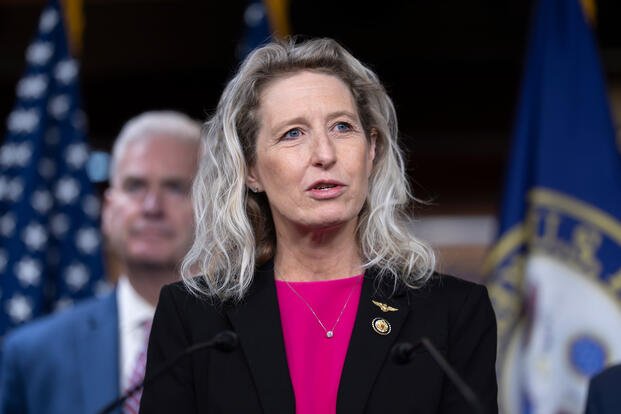
“This is a strong bipartisan bill that delivers for our warfighters and deters our adversaries,” House Armed Services Committee Chairman Mike Rogers (R-AL) said on the House floor prior to the bill’s passing. “It will fundamentally reform the defense acquisition enterprise. It will continue historic improvements in the quality of life for our servicemembers and their families.
“It will build the ready, capable, and lethal fighting force we need to deter China and our other adversaries. And it will deliver on President Trump’s Peace Through Strength agenda. I urge all members to support it.”
Rep. Adam Smith (D-WA), the ranking Democrat on the committee, called the bill “the most ambitious swing at acquisition reform that we’ve taken,” according to the Associated Press.
“This NDAA falls short. Trump and [Defense Secretary Pete] Hegseth are deploying troops to our streets, carrying out extrajudicial killings, and undermining our military readiness. Congress must reassert its oversight. We need accountability—not just handouts to Trump,” said Rep. John Garamendi (D-CA), a senior Armed Services Committee member, in a post on X.
Big Money
The House-passed bill in part authorizes some military construction projects and extends their authorization from previous fiscal years; requires the Department of Defense to develop a national strategy on the security implications of emerging biotechnologies; requires the Navy to implement certain processes to improve combat readiness of surface ships maintained and repaired at private shipyards; and extends the Pacific Deterrence Initiative which designed to enhance U.S. deterrence and defense posture in the Indo-Pacific region.
A GOP-issued summary of the legislation says the NDAA authorizes $291 billion for maintenance and operations; $234 billion for military personnel and health care; $162 billion for procurement; $146 billion for research and development; $34 billion for nuclear defense programs; and $20 billion for military construction and family housing.
Lawmakers say the FY 2026 bill overall will save taxpayers nearly $20 billion, including $40.5 million from eliminating DEI activities; $1.6 billion in cuts to climate change-related spending; $1.2 billion from retiring obsolete aircraft and ships; $6.8 billion from reductions in “unnecessary Pentagon bureaucracy”; $5.5 billion in cuts to consulting and service contracts; and $3.7 billion in cuts to inefficient defense programs.
NDAA’s Major Inclusions
Some of the NDAA’s major highlights are as follows:
-
A 3.8% pay raise for all military servicemembers, in addition to reauthorizing and expanding military bonuses and special pays; increases family separation allowance for deployed servicemembers; and requires a study to improve the calculation of Basic Allowance for Housing to ensure it keeps up with rising rental costs.
-
$400 million for Ukraine security assistance.
-
It extends the Pacific Deterrence Initiative (PDI) to improve U.S. posture in the Indo-Pacific region, including funding increases for new technologies needed to deter China such as hypersonic missiles, AI, autonomous systems, cyber, mobile micronuclear reactors, and high energy lasers. That includes over $2.7 billion in essential military construction projects and expands in that region.
-
Full funding ($1 billion) towards the Taiwan Security Cooperation Initiative.
-
$1.5 billion in new security assistance for the Philippines.
-
It formally establishes and authorizes $175 million for the Baltic Security Initiative to strengthen the defensive capability and interoperability of the Baltic states.
-
Full funding for the deployment of National Guard and active-duty troops in support of border patrol at the United States’ southwest border, including over $1 billion to fight drug trafficking ($398 million for Defense Department support of counter-narcotics operations and $216 million for National Guard counter-drug programs—$100 million over the budget request).
-
Reforms to military construction that costs 35% more on average than commercial construction, including accelerating construction and reducing costs by granting military departments multiyear contracting authority and authorizing the use of accelerated design-build and progressive design-build contracting methods to cut costs and speed up projects.
-
Oversight of Defense Department spending by way of fully funding the department’s Inspector General audit activities and requiring the department to submit quarterly reports to Congress on the status of balances and activities of funds previously approved within the One Big Beautiful Bill Act earlier this year.
-
More than $131 million for the construction of new military dining facilities and over $1.5 billion for new construction of barracks and family housing.
-
More than $335 million to renovate military hospitals and build new medical facilities, which includes better access to specialty care by lowering the threshold for travel reimbursement for medical appointments from 100 to 75 miles.
-
More than $491 million to design and build new childcare centers, including annual reviews of childcare costs and a pilot program to increase childcare financial assistance in high-cost areas.
-
More than $206 million to build new schools for children of servicemembers and allows National Guard and reserve members called to active duty to enroll their children in Defense Department schools. It also authorizes $50 million in Impact Aid assistance to public schools with military dependent students, and an additional $20 million in assistance to local schools teaching children with severe disabilities.
-
It extends military recruitment bonuses.
-
It prohibits the retirement of certain F-15E, A-10, C-130, E-3, RQ-4, and Grey Eagle aircraft, as well as the closure of the E-7A Wedgetail production line.
-
$26 billion in shipbuilding funding for the construction and support of numerous vessels including the third Columbia-class Ballistic Missile Submarine, one Virginia-class Submarine, one anti-submarine warfare auxiliary ship, and future procurements.
-
More than $38 billion for the development, procurement or modification of aircraft including full funding for the U.S. Air Force’s F-47 and Navy’s F/A-XX 6th Generation Aircraft programs.
-
Builds the “Golden Dome” to update national missile defense policy.
What’s Not in the Bill
Some of what was excluded in the final version are as follows:
-
The final bill ultimately did not include a provision mandating health care coverage for assisted reproductive technology, including in vitro fertilization (IVF), for all active-duty service members. As previously reported by Military.com, some Democrats and numerous reproductive organizations warned prior to the final version that its removal would prevent the expansion of IVF access to all servicemembers due to current insurance plans through TRICARE.
-
It permanently repeals all existing Defense Department diversity, equity and inclusion (DEI) offices, programs, training and activities, as well as future DEI-related endeavors.
-
It cuts climate change-related programs at the Defense Department.
-
It removes Section 1110, the bipartisan House provision that would have restored collective bargaining rights for the Defense Department’s civilian workforce and would have prevented the department from using the bill’s funds to enforce an executive order that strips collective bargaining rights from hundreds of thousands of DoD civilians.
Rep. Bob Onder (R-MO), urged GOP colleagues in November to strip the provision from the final call, saying in an X post that it was “designed to stop union bosses from slowing down critical defense operations by pushing ineffective policies that hurt productivity” and would cause “political interference.”
Hegseth’s Travel Budget Tied to Caribbean Boat Strikes
The House-passed version also includes a provision to withhold a quarter of Defense Secretary Pete Hegseth’s travel budget until the Pentagon provides Congress with unedited videos of Caribbean airstrikes against alleged drug smuggling boats, according to reports.

It was included on the heels of the ongoing controversy surrounding orders to allegedly kill two survivors from a Sept. 2 strike, and further investigations by GOP-led House and Senate committees into whether that second strike was properly authorized and amounted to war crimes. The investigations remain ongoing.
Codifying Trump’s Executive Orders
The NDAA also codifies all or parts of 15 executive orders issued by President Trump, including the following:
-
Restoring America’s Fighting Force (EO 14185)
-
Ending Radical and Wasteful Government Diversity, Equity, and Inclusion (DEI) Programs and Preferencing (EO 14151)
-
Declaring a National Emergency at the Southern Border (Proclamation 10886)
-
Securing Our Borders (EO 14165)
-
Clarifying the Military’s Role in Protecting the Territorial Integrity of the U.S. (EO 14167)
-
Modernizing Defense Acquisitions and Spurring Innovation in the Defense Industrial Base (EO 14265)
-
Building the Golden Dome for America (EO 14186)
-
Deploying Advanced Nuclear Reactor Technologies for National Security (EO 14299)
-
Restoring American Airspace Sovereignty (EO 14305)
-
Unleashing American Drone Dominance (EO 14307)
Story Continues
Read the full article here