




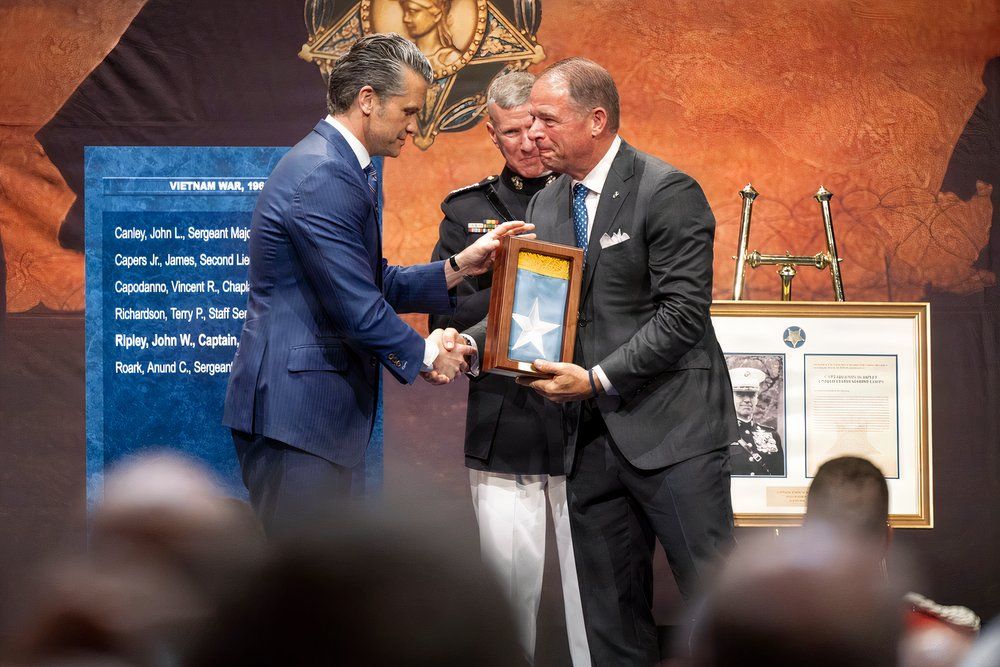
More than 54 years after he crawled beneath the Dong Ha Bridge to stop a North Vietnamese armored invasion, Marine Col. John Ripley entered the Pentagon’s Hall of Heroes on Thursday.
For generations of Marines, the moment represented recognition of one of the most legendary acts of battlefield leadership in the Vietnam War. But for Ripley’s son, Tom, the ceremony was about far more than a medal.
In an exclusive interview with Military.com following the ceremony, Tom Ripley said the Medal of Honor awarded to his father represents the Marines who fought beside him, the military spouse who held their family together through two Vietnam tours, and the generations of service members who carried the story forward for more than half a century.
“This is not my award,” Ripley said. “When people would stand up and clap, I would clap too.”
As applause filled the Pentagon’s Hall of Heroes, Ripley found himself thinking not just about his father, but about the hundreds of Marines, sailors and South Vietnamese service members whose sacrifices became part of the Dong Ha Bridge story.
Throughout his remarks at the Pentagon, Ripley repeatedly returned to a lesson his father taught throughout his life: Nothing great is ever accomplished by the individual. It’s always accomplished by the team.
That belief, more than the Medal of Honor itself, shaped the story Tom Ripley wanted people to remember.
The Bridge That Stopped an Army
The action that led to the Medal of Honor has become one of the most studied episodes in Marine Corps history.
On Easter Sunday, April 2, 1972, then-Maj. John Ripley was serving as an advisor to the South Vietnamese Marine Corps near Dong Ha in northern South Vietnam when the North Vietnamese Easter Offensive surged south with overwhelming force.
Across the river stood a massive invasion force.
According to Tom Ripley, more than 50,000 North Vietnamese troops, supported by over 100 tanks and multiple divisions, were preparing to advance. The Dong Ha Bridge represented the only crossing capable of supporting that armored force.
Ripley knew the bridge had to be destroyed.
Using explosives carried by hand, he climbed beneath the bridge and made repeated trips across its steel girders while enemy forces closed in. South Vietnamese Marines held the line with anti-tank weapons and machine guns while Ripley rigged the structure for demolition.
At one point, exhausted and hanging beneath the bridge, he repeated a simple prayer:
“Jesus, Mary, get me there.”
When the charges detonated, the bridge collapsed into the river below.
The destruction halted the armored advance long enough for U.S. airpower and naval gunfire to attack the concentrated enemy force.
Years later, Ripley reflected on the mission with characteristic honesty.
The idea that I would even finish the job before the enemy got me was ludicrous, he said. When you know you’re not going to make it, a wonderful thing happens. You stop being cluttered by the feeling that you’re going to survive.
Yet if you ask Tom Ripley what his father would want people to remember, the answer isn’t the bridge.
It’s the team.
“Nothing great is ever accomplished by the individual,” Tom said, repeating one of his father’s most enduring lessons. “It’s always accomplished by the team.”
That message became the central theme of his remarks at the Hall of Heroes ceremony.
The Men Behind the Medal
Throughout both his remarks and his interview with Military.com, Tom Ripley repeatedly redirected attention away from his father and toward the Marines, sailors and soldiers who fought beside him.
He spoke of Lt. Col. Gerry Turley, the senior Marine advisor who helped coordinate the desperate defense.
He spoke of Marine officers such as Walt Boomer and Ray Smith, whose units were fighting across the battlefield as North Vietnamese forces overran firebases throughout the region.
He spoke of Lt. Joel Eisenstein, who flew into danger to support Marines trapped in the fighting.
He spoke of the sailors aboard USS Buchanan and the destroyers that joined her in delivering devastating naval gunfire support.
Most importantly, he spoke about the South Vietnamese Marines who suffered enormous casualties while holding back a much larger force.
“On March 30, just three days before destroying the bridge, 650 men of the South Vietnamese Marines 3rd Battalion were committed as the reserve,” Tom said during the ceremony. “A week later, just 52 men stood in formation.”
For Tom Ripley, that statistic is central to understanding the battle.
“There are hundreds and hundreds of people doing their job thanklessly, quietly, no recognition, no accolades,” he told Military.com. “Just doing their job to try to help advance the cause.”
That perspective is one reason many Medal of Honor recipients describe the award not as an award but as a responsibility.
“In some ways, the medal is a responsibility,” Ripley said. “Because you have to tell the stories of the other people.”
For many of the Vietnam veterans who attended the ceremony, the recognition carried significance far beyond one Marine.
“One of theirs is being recognized for something they all went through.”
A Family Defined by Service
The story of John Ripley is also the story of a family deeply rooted in military service.
“My family’s history is rooted in military service,” Tom Ripley said during his remarks.
His father and his father’s brothers all served as Marine officers during Vietnam. One of those brothers, Capt. Mike Ripley, a Marine fighter pilot with VMFA-231, was killed in service on June 18, 1971.
The timing was especially meaningful because the Medal of Honor ceremony occurred just one day after the anniversary of Mike Ripley’s death.
Tom Ripley and his brother later became Marines themselves. His nephews serve as Marines today.
His son recently graduated from the Naval Academy and commissioned into the Navy.
It’s not something we talk about,” Ripley said in an earlier interview with Military.com. “It’s something we live.
For the Ripley family, military service isn’t simply a chapter of family history. It spans generations.
“As a father,” Tom said during the ceremony, “I take great comfort in the leadership and lethality of our armed forces. It is stronger today than it has ever been.”
 The Partner Behind the Warrior
When asked what his father would have done had he been alive to receive the Medal of Honor himself, Tom Ripley didn’t hesitate.
He would have thanked his wife first.
“I’ve never attended an award ceremony or promotion with my father where the first thing he did wasn’t recognize and thank my mother,” Ripley told Military.com.
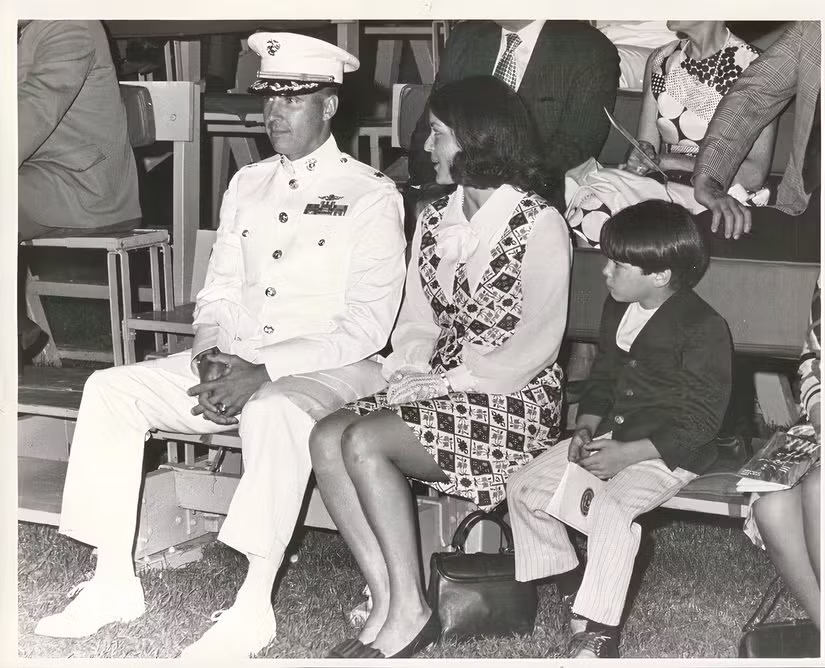
At the ceremony, he described his mother as the “quintessential military spouse.”
When John Ripley destroyed the Dong Ha Bridge, he was on his second combat tour in Vietnam. Back home, his wife was raising four young children, including a seven-year-old son and a five-year-old daughter.
“The silent fight that military spouses fight every day is nothing short of remarkable,” Ripley said.
His father often summarized that relationship with a phrase Tom repeated during the ceremony:
“Next to every great man is a woman who expects nothing less.”
Later, reflecting on military families more broadly, Ripley called spouses one of America’s hidden strengths.
“In many ways, that’s our secret weapon,” he said. “It’s this balance and this ability to go and do the hard things. It liberates you to go do the incredibly difficult thing your country asks you to do.”
‘It’s Never Too Late, or Too Hard, to Do the Right Thing’
Tom Ripley began his remarks in the Hall of Heroes with a lesson he said defined his father’s life.
“It’s never too late, or too hard, to do the right thing.”
The phrase carried special meaning on a day that arrived more than five decades after the battle at Dong Ha Bridge.
Speaking with Military.com afterward, Ripley said the Medal of Honor represented more than recognition for one Marine. It represented leaders at every level being willing to revisit history and correct what many Marines believed was an unfinished story.
Leadership is making the hard decisions and having the fortitude to bear the consequences, Ripley said during the ceremony.
He specifically credited President Donald Trump, Defense Secretary Pete Hegseth, Chairman of the Joint Chiefs of Staff Gen. Dan Caine, Commandant of the Marine Corps Gen. Eric Smith, Marine Corps leaders, historians and numerous advocates who worked for years to revisit the case.
“This team is on a mission to correct the record, to fix the unfixable, and to do the right thing regardless of the cost,” Ripley said.
In his view, the Medal of Honor was never about rewriting history. It was about ensuring history reflected what happened.
For many Marines, that effort represented an act of leadership itself.
 Why It Matters to Marines Today
Within the Marine Corps, John Ripley’s story has become far more than a battlefield tale. It has become a leadership lesson.
The training he received as a Marine officer, Force Recon Marine, Army Ranger School graduate and Royal Marine Commando gave him the skills to destroy the bridge. But the lesson Marines remember is not technical. It is personal.
Ripley often told younger Marines that “leadership is a contact sport.”
You have to be where the fight is. You have to be where the decisions matter.
You have to be willing to accept responsibility when the mission depends on you.
For generations of Marines, Dong Ha Bridge represents those principles in action.
That is why so many Marines spent decades advocating for the Medal of Honor review.
And that is why Thursday’s ceremony felt less like a new chapter and more like the final page of a story many believed should have been completed years ago.

Finishing the Story
For decades, Marines who knew the Dong Ha story asked the same question.
Why wasn’t it a Medal of Honor?
Tom Ripley heard that question throughout his life.
“When people would come to me about my father, they would always say, ‘Didn’t he get the medal?’ or ‘He should have gotten the medal?'”
Now, after years of efforts by fellow Marines, historians, military leaders and multiple administrations, that question has finally been answered.
But even after the Medal of Honor presentation and Hall of Heroes induction, Tom Ripley views the moment less as a celebration than as a correction.
For the Marines who fought at Dong Ha, for the veterans who carried those memories for decades, and for a son who spent a lifetime preserving his father’s story, the ceremony represented something deeply meaningful.
The story was finally complete.
Two days after the bridge fell and the invasion stalled, John Ripley was asked to provide a situation report over the radio.
More than half a century later, his son chose those same words to close his remarks at the Pentagon.
“Leatherneck Delta reports. Powder dry. Morale high. Semper Fi.”
Read the full article here